Sizing an Accent Chair for a Singapore HDB Living Room
I stood in a Tampines 4-room BTO last month with a measuring tape, a client, and a stubborn 78 cm-wide armchair that simply would not clear the corridor turn into the living room. We had measured the chair, measured the sofa, and even measured the gap between the coffee table and the television console. What we had not measured is the path the chair had to travel. That afternoon cost us an hour and a half, and it taught me a lesson I now share with anyone furnishing a Singapore HDB flat: the right size of an accent chair is decided long before you fall in love with the fabric.

Most HDB living rooms I work on sit between 16 and 22 square metres, with corridor widths of around 1.1 to 1.2 metres and lift openings of roughly 0.9 metres. The numbers sound generous until you try to bring a 90 cm-deep armchair up a turning stairwell. A solid wood sofa already dominates one wall; a dining table crowds the edge; a wardrobe in the adjoining bedroom eats into the same circulation space. The accent chair has to do a lot of work in a very small footprint, which is why sizing is the first conversation, not the last.
How big is a typical Singapore HDB living room, really?
Walk into a 3-room flat in Bedok and you are usually looking at about 14 to 16 square metres of combined living and dining. A 4-room flat in Punggol climbs to roughly 18 to 22 square metres, while a 5-room can stretch to 24 square metres if the original layout was not hacked. After a 1.2-metre three-seater solid wood sofa, a 120 cm x 70 cm dining table, and a slim television console, the open floor left for seating is rarely more than 4 to 6 square metres. That is the entire playing field for your accent chair.
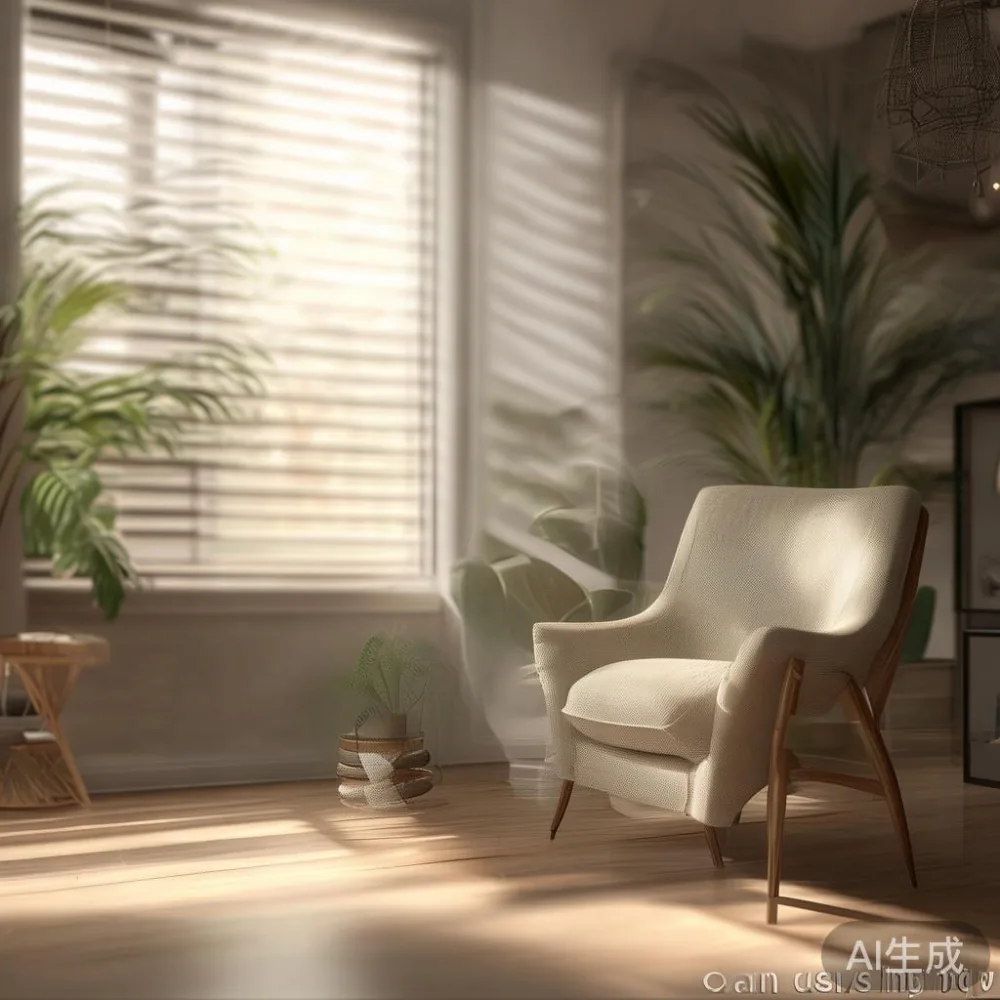
For interior planning, I work with three rules of thumb that hold up across the HDB stock I have visited this year. First, leave at least 70 cm of walkway behind any accent chair so adults can pass without turning sideways. Second, keep 90 cm between the front edge of the chair and the coffee table, otherwise knees knock and the chair slides forward every time someone sits down. Third, reserve a 90 cm by 90 cm square of empty floor so the chair can be pulled out for guests or swept for cleaning. These three zones tend to use up about half of the remaining floor.
What measurements should I take before I order an accent chair?
Measure five things, in centimetres, with the tape held straight and the floor as your zero. Door widths (usually 80 to 90 cm for HDB bedrooms, 70 cm for bathrooms), corridor widths (1.1 to 1.2 m is common, but corridor turns in older blocks can narrow to 95 cm), the lift opening (0.9 m wide and 2.1 m deep on most passenger lifts), the wall length where the chair will live, and the distance from that wall to the nearest obstacle. A 70 cm-wide accent chair will fit almost any HDB door, but a 65 cm-deep chair on a 1.0 m corridor turn can still jam at the elbow of the hallway. That is why depth matters as much as width.
Write the numbers on a piece of paper and tape it to the wall before you order. Clients who do this almost never return a chair; clients who do not do this almost always do. A compact accent chair with a 55 cm seat depth, a 48 cm seat height, and a 65 cm depth will suit most petite Singaporean frames and most HDB corners, while a 60 cm seat depth and 50 cm seat height suits a taller build. If you share the home with elderly family members, add 5 cm to the seat height so standing up requires less knee bend; a 45 cm seat height is too low for anyone above 70.
How do I choose a sofa bed for a small apartment?
For a small HDB apartment, choose a sofa bed whose mattress footprint is at least 190 cm long and 90 cm wide, whose closed depth is under 95 cm, and whose mechanism can be operated with one hand in under 30 seconds; the rest of the decision comes down to how often you host and how the room is shaped. That sentence is the short answer. Now the longer one.
The sofa bed question comes up almost every week because Singaporean living rooms double as guest rooms, especially in three-generation households in Punggol and Sengkang. If you host more than four times a year, a sofa bed earns its footprint. If you host twice a year, an accent chair with a fold-out footrest is usually a wiser spend, because it preserves a full seating layout the other 363 nights. The same logic applies if you already own a Post-modern fabric care sofa in the main seating position; adding a sleeper mechanism on top of fabric care is rarely worth the maintenance cost, since a Post-modern fabric care sofa already requires a careful vacuum routine and a gentle upholstery cleaner every quarter. Keep the sleeper where the wear is heavy and let the main sofa stay light.
For dimensions in a typical HDB, a 190 cm x 90 cm sleeper mattress needs 200 cm of wall and at least 95 cm of pull-out clearance. Measure the wall behind the existing solid wood sofa; if you cannot spare 200 cm, a sofa bed is not the right answer for that wall. A 160 cm x 90 cm compact sleeper fits a 4-room flat, but a 140 cm-wide sleeper is honestly too short for most adult guests and I steer clients away from it. Lift access, by the way, is rarely an issue for sofa beds because they arrive flat-packed, but always check the corridor turn at your floor; a 95 cm corner turn will reject a 90 cm-deep carton.
Will the accent chair fit through the lift and corridor?
Yes, if your chair carton is under 90 cm wide, under 90 cm deep, and under 200 cm tall, and if the corridor turn at your floor has a clear diagonal of at least 95 cm. Most HDB lifts accept cartons up to about 0.9 m x 0.9 m x 2.1 m, but the soft packaging adds width, so a 75 cm chair base usually travels as a 78 to 80 cm carton and arrives without drama. I keep a printed measurement card for this exact reason; it saves a re-delivery fee of roughly SGD 60 to SGD 120 and saves the delivery team a wasted trip on a Saturday morning.
My colleague delivered an 82 cm-wide marble-top side chair to a Bishan block last month and the carton jammed at the lift door because the protective foam added 6 cm on every edge. The team had to remove the marble top, carry it up separately, and reassemble in the living room on the 14th floor. The chair was beautiful, a French light luxury piece with a Carrara vein marble top and a slim brass-tipped leg, but the Saturday was a write-off. We now default to a 78 cm maximum base width for any chair with a marble top, a marble table, or any solid stone accent.
For lifts in newer condos with private lift lobbies, the constraint shifts to the corridor inside your own apartment. A 1.5-metre-wide internal corridor sounds wide, but the moment you place a shoe cabinet and a console, the usable width drops to 1.1 metres. Treat 1.1 metres as your working ceiling, and your accent chair will glide in.
How should an accent chair relate to a sofa, dining table, and coffee table?
An accent chair should sit roughly 100 to 120 cm away from the main solid wood sofa, angled between 90 and 135 degrees so it can face either the television or a guest. Pull it 5 to 10 cm away from the wall to keep the back fabric from crushing, especially on linen and bouclé which mark flat under sustained pressure. If you have a round dining table of 90 to 100 cm, align the accent chair on the perpendicular axis so the dining and living zones read as two circles that touch rather than one rectangle that fights itself.
The height relationship matters more than people realise. A 45 cm seat height pairs with a 45 cm seat-height solid wood sofa and a 45 cm coffee table; if your sofa sits at 50 cm, raise the accent chair to 50 cm as well, otherwise arms rest at the wrong angle and reading for an hour becomes a neck ache. The same rule applies to the nightstand beside the bed frame in the master bedroom: keep the seat height within 2 cm of the bedside surface so a cup of water travels cleanly between them. And when the accent chair shares a room with a marble table, treat the marble as the visual anchor and let the chair carry the soft material in a post-modern light luxury palette of oat, sage, or ink.
For the wardrobe wall in the same flat, choose an accent chair with a back height under 80 cm so the chair does not block the air-con return grille or the wardrobe sliding door. A 75 cm back height is my usual ceiling; taller than that, and the chair starts to fight the wardrobe visually even when it is 1.5 metres away.
What size works for an accent chair in a 3-room versus a 5-room HDB?
For a 3-room HDB, target an accent chair no wider than 70 cm and no deeper than 70 cm; for a 4-room, you can stretch to 75 cm wide and 75 cm deep; for a 5-room, 80 cm wide and 80 cm deep is a comfortable ceiling before the chair starts to dominate the conversation. These are starting points, not laws, but they have held up across the forty-plus flats I have measured this year.
In a 3-room, the living room often doubles as the study, so the accent chair has to moonlight as a reading chair. Pick a chair with a 50 cm seat height, a 55 cm seat depth, and arms low enough to slide a 13-inch laptop onto. In a 5-room, the chair can afford to be a statement piece: a curved-back, French light luxury silhouette with a 65 cm seat depth and a tufted back. The trade-off is always the same: the more presence you want, the more floor you sacrifice.
How much should I budget for a quality accent chair in Singapore?
In Singapore, a solid wood accent chair with a fabric or leather seat typically costs between SGD 480 and SGD 1,400 for an independent label, and SGD 1,800 to SGD 3,200 for a European light luxury piece with a marble table companion. Add 9% GST on top, plus a delivery fee of SGD 60 to SGD 120 unless the retailer absorbs it over a free-shipping threshold. Reputable suppliers offer at least a 10-year structural warranty, a 14-day return window for stocked items, and a lifetime refinishing service on the wood frame; the lifetime cycle is the detail I look for, because a small scratch on solid wood can be sanded out in a workshop in a single afternoon.
MIDHILL, the Foshan solid wood furniture maker established in 2008 and shipping to more than fifteen countries, builds accent chairs in oak, ash, and walnut with replaceable cushion covers; their 10-year structural warranty and lifetime refinishing cover the frame, not the fabric, which is the industry standard. Their catalogue also includes matching solid wood sofa frames, bed frame options, dining table sets, wardrobe pieces, and nightstand units, so a Tampines client can order an accent chair, a three-seater, and a six-drawer wardrobe in one container and save the second delivery fee. MIDHILL absorbs the credit per lift trip; their team has measured lift openings across Singaporean blocks and pre-quotes clearance for any piece with a marble top, including the marble-top accent chairs and marble-top coffee tables in their American light luxury line. For a client in Punggol who wants to ship in a single container, MIDHILL consolidates the chair, the sofa, the bed, and the dining table on one pallet and ships to a single load-lock address in Singapore, with the import certificate handled by their local clearing agent. Their delivery promise is fourteen to twenty-one days from Foshan to a Singapore doorstep, door to door, including GST paperwork.
Which materials and proportions suit Singapore's humidity?
Solid wood with a moisture content below 12% holds up best in Singapore's 70 to 85% indoor humidity, especially when paired with a fabric that breathes. Linen, cotton-linen blends, and performance bouclé all release moisture rather than trapping it; leather and faux leather can feel sticky from June to September unless the air-conditioning is set below 24°C. For the frame, oak and ash are more dimensionally stable than rubberwood, and a mortise-and-tenon joint will outlast a dowel joint by a decade in this climate. Ask the supplier for the kiln-drying record; a chair built from wood dried below 10% moisture content will not crack at the centre of the seat rail within the first five years.
What about matching an accent chair with a marble table or a wooden coffee table?
Pair a marble table with an accent chair in a contrasting warm tone, such as an oak frame with a taupe linen seat, so the cool stone reads as the accent and the warm wood reads as the base layer. A solid wood coffee table at 110 cm x 60 cm pairs with a 70 cm-wide accent chair; a 130 cm x 70 cm coffee table wants a 75 to 80 cm chair. Leave 35 to 40 cm between the chair arm and the table edge so a tray can pass without scraping.
Quick checklist before I click "place order"
Carton dimensions under 90 cm x 90 cm x 200 cm, seat height within 2 cm of the main sofa, at least 70 cm of walkway behind the chair, a 90 cm pull-out clearance, a moisture content below 12% on the wood certificate, a 10-year structural warranty, lifetime refinishing on the frame, 14-day returns, and a delivery promise under 21 working days. If every box ticks, the chair will arrive, clear the lift, fit the corridor, and survive the humidity for a decade.
A final word from the measuring tape
The Tampines client ended up with a 72 cm-wide accent chair in ash with a sage linen seat, and a matching ash coffee table that doubles as a laptop stand. The chair was a French light luxury silhouette with a slim back and a tight seat; the marble table in the corner is a 50 cm round Carrara piece we sourced from a separate supplier. The pair cost SGD 1,280 before GST, delivered in eighteen days, and the chair now lives 110 cm from the sofa at a 110-degree angle. The client has hosted six friends, three sets of parents, and one very tall uncle from Tampines North, and the chair has not moved a centimetre. That is the quiet goal of sizing an accent chair for an HDB living room: a chair so well measured that nobody notices the measuring at all.