What to Check Before Buying a Sofa You Cannot Sit On
A sofa that looks perfect in a showroom can become an impractical piece of furniture the moment it reaches a Singapore home. The dimensions may be right on paper, but a narrow lift, a turning corridor, and a compact HDB living room can change everything. You may also be buying it for appearance, occasional use, or a room where an extra seat is needed rather than for everyday lounging. That makes the phrase “a sofa you cannot sit on” less about discomfort and more about planning.
For homeowners in Tampines, Bedok, and Punggol, the key checks are access route, usable dimensions, comfort, support, and delivery arrangements. The same sofa can suit one condo and fail another: a 220 cm model might fit through a broad private lift but not a 190 cm HDB service lift, while a low-profile design may look elegant beside a balcony door yet leave too little space to walk around.
MIDHILL makes solid wood furniture for international buyers, with a focus on practical construction and light-luxury styling. The principles below apply whether you are considering a MIDHILL sofa, an upholstered three-seater from another maker, or a custom solid wood sofa with a stone or timber base. Prices are shown in SGD so that the examples remain useful for local planning.

Do you really need a sofa you cannot sit on?
Sometimes the question is not literal. A sofa can be a display piece in a living room, a occasional-use seat in a study, or a decorative shape that preserves floor space in a compact flat. If that is the intention, call it a display sofa or occasional chair rather than pretending it is an everyday seat. A display sofa should still be safe, stable, and proportioned correctly; “not for sitting” does not mean flimsy or unsuitable for the room.
Begin with the room, not the catalogue. Measure the wall where the sofa will sit, the television console, the coffee table, the balcony door, and at least 75 cm of circulation space where people need to pass. A sofa can be 200 cm wide and still feel crowded if it projects 95 cm into a room and leaves only 40 cm between its front edge and the dining chairs. For a typical Singapore living room, a total sofa length of 180–220 cm is often more manageable than a 240–280 cm statement piece.

Think about the intended use. A family sofa should accommodate an adult sitting upright, a child lying across it, and a person wearing a book or using a laptop. A display sofa may need only a level seat surface of 40–45 cm deep. In other words, the right product for a 12-by-18-foot HDB living room may be a compact two-seater, an accent chair, or a modular bench rather than a large fixed sofa.
What measurements should you take before ordering?
Measure the actual delivery path, not just the doorway. In many HDB blocks, the main door is not the narrowest point. The route may include a staircase landing, a service corridor, a fire door, the lift lobby, and the lift itself. Record the width and depth of the lift door, the internal lift dimensions, the corridor turns, and any threshold that cannot be removed. Allow a little working room for packaging and handling: approximately 5–10 cm on tight routes.
A standard Singapore passenger lift may have an internal cabin around 110 cm wide and 140 cm deep, although older blocks and newer accessible lifts vary. A long sofa can be turned on its side if it is light enough and the furniture has no fixed high back, but a solid wood sofa with a heavy frame should not be lifted diagonally by one person. Ask the seller for the packed dimensions and weight before paying. A 65 kg sofa handled by two people is a different delivery job from a 28 kg accent chair carried by one person.
For corner corridors, measure the diagonal of the tightest turn rather than assuming the corridor width equals the available turning space. In a condo, the private lift may be larger, but the owner must still confirm its permitted load. A furniture lift rated for 600 kg can still fail if the sofa is awkwardly positioned or if the route includes glass panels and sharp turns.
The finished dimensions should be checked against the room. Leave 75–90 cm between a sofa and coffee table, maintain around 60–75 cm beside major seat ends where possible, and keep 90 cm in front of a balcony or service door. These are planning guides, not fixed building rules. The more important point is to test whether someone can walk from the entrance to the kitchen without squeezing past the sofa.
How should you test comfort without sitting on the showroom sofa?
You do not need to sit for 30 minutes to learn whether a sofa is usable. Sit for 5 minutes, stand up, and notice whether you need to shuffle forward. Check the seat height, depth, and angle. A seat that is approximately 40–43 cm high works for many adults, while a deep seat of 65–75 cm may suit a lounge design but leave a shorter person’s feet unsupported. The back should support the lower back without forcing a slouch.
Seat density and construction matter more than a dramatic label. A solid wood sofa gives you a stable frame, but the upholstered cushions determine much of the comfort. Press the seat cushion with your palm: it should recover rather than remain permanently dented. Sit on the front, middle, and rear edge to check whether it tips. If a display sofa is firm by design, the product description should state the seat firmness and thickness clearly.
Last month I visited a client’s Bedok flat to inspect a newly delivered sofa that had looked ideal in a photograph. The sofa measured 198 cm wide and fit through the service lift, but it projected 88 cm into the room. The owner wanted a 55 cm coffee table, which left only 55 cm of passage. We moved the table away from the sofa and placed it on a 90 cm rug; the room immediately felt more open. The lesson was simple: check the room as a moving system, with the sofa, table, and walking space together.
If the sofa will be used by older relatives, choose a seat that is easier to rise from than one that sinks deeply. A firmer cushion at 42–45 cm high may be more practical than a softer 38 cm seat. If the piece is mainly decorative, a clean silhouette may matter more than plushness, but it should still have a usable seat height of roughly 38–43 cm and a stable footprint.
How do access, weight, and delivery terms affect your choice?
Before placing an order, obtain four figures: product dimensions, packed dimensions, product weight, and the delivery timeline. Ask whether delivery is curbside, room-of-choice, or into the lift lobby. A quotation for “free delivery” may mean delivery to the ground floor only. Confirm whether carrying fees, stair charges, assembly, and lift reservation costs are included.
For a Singapore purchase, a delivery window of 7–14 working days is reasonable for a made-to-order solid wood sofa, while an in-stock item may arrive in 3–7 working days. Custom upholstery can take 6–10 weeks. These examples show why the seller should state a written estimate rather than a vague “soon.”
Check the return policy and the condition requirements. A 14-day return period is useful, but the sofa should be unused and protected with its original packaging. Custom-made pieces may have different return terms because they cannot be resold in the same condition. A structural warranty of 10 years is meaningful for a solid wood frame, but confirm whether it covers frame joints and structural components rather than every surface, cushion, or accidental damage.
Payment and GST should also be clear. For example, a SGD 3,200 sofa before GST becomes SGD 3,424 after 9% GST. Some retailers absorb GST in displayed prices, while others show it as a separate line. Compare the final payable amount, delivery charges, and any deposit. A balance of SGD 960 on a SGD 1,200 order is still money committed before inspection.
MIDHILL offers a 14-day return policy, a 10-year structural warranty, lifetime refinishing on applicable solid wood pieces, and free shipping above US$350. For local purchases, the seller should still provide an SGD-denominated final price and a Singapore-specific delivery arrangement.
Which materials and construction details deserve a closer look?
For a solid wood sofa, ask which timber is used in the load-bearing frame, how the joints are made, and whether the frame is kiln-dried. Look for solid wood in the main rails, legs, and back structure rather than relying on a general “wood furniture” description. Ask about plywood or engineered components used in non-structural panels. A clear material schedule is more useful than a fashionable photograph.
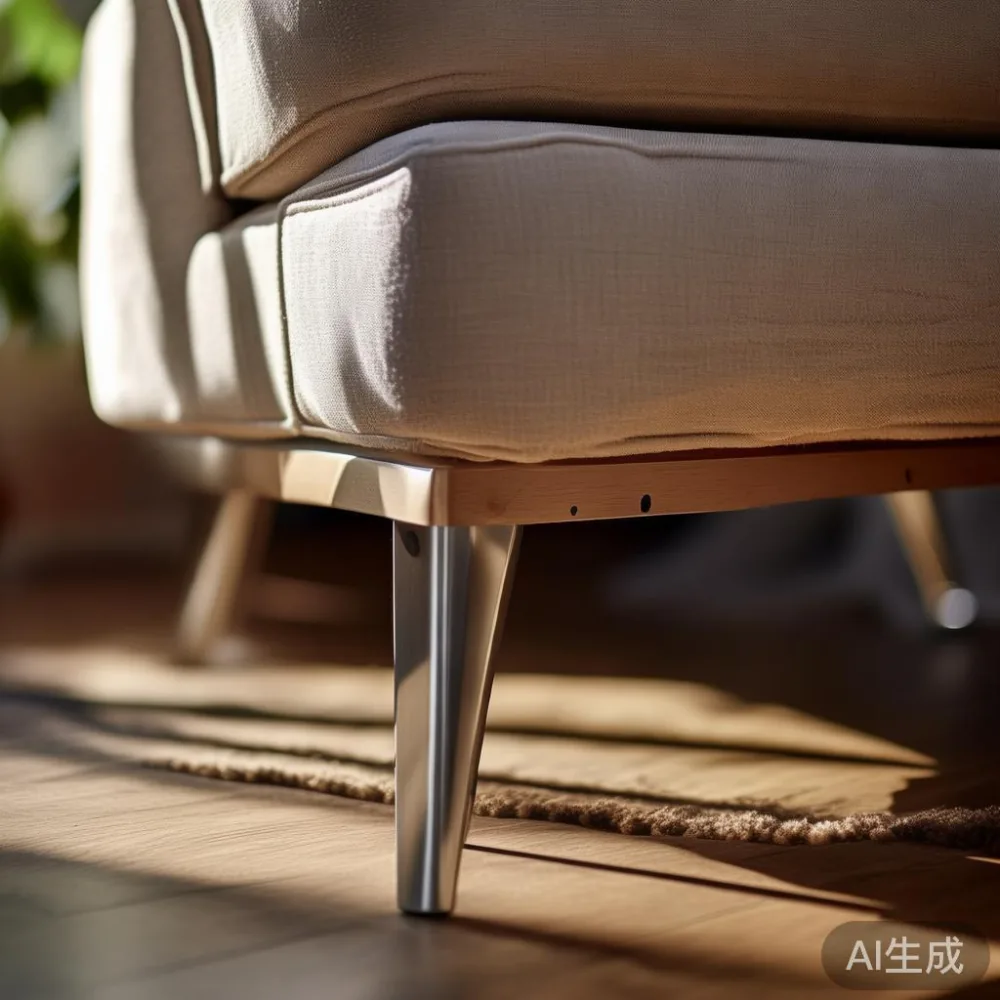
Check the leg construction and floor protection. In Singapore’s humid conditions, solid wood should be finished with a suitable protective coating, while hardware should be checked for corrosion resistance. The sofa should sit on floor protectors rather than directly dragging a hard wooden leg across tile. For a light-luxury appearance, tapered legs can make the piece feel lighter, but the support must still be firm.
Upholstery needs a sample or clear specification. Ask for the fabric composition, cushion filling, foam density, and fire-safety information where relevant. A removable cover may be useful in a family home; a performance fabric may be easier to clean. Avoid assuming that “linen blend” means the whole cover is linen or that “leather” means full-grain leather. If you want a stone-look centre table beside it, compare the material with a European light luxury coffee table rather than judging the finish from a showroom reflection.
Design vocabulary can help you identify a direction. French provincial for dining room styling is usually associated with carved edges, warm woods, and curved profiles, so it should not be used to describe an unrelated sofa. American light luxury often means clean upholstery, balanced proportions, and restrained timber details. Post-modern light luxury can include simplified geometric forms and mixed materials. At the same time, the category should remain an accent-chair or sofa-focused room, not a general catalogue of unrelated furniture.
How do you compare a sofa with an accent chair?
If your main concern is preserving circulation space, an accent chair may be the more rational option. A typical accent chair measures 65–80 cm wide, 70–85 cm deep, and 75–95 cm high. It can provide a defined seat without occupying the full wall length of a sofa. Two accent chairs can face each other around a compact table, but they still need 45–60 cm of clearance for pulling out and sitting down.
The trade-off is flexibility. Two accent chairs may look balanced but provide fewer places to stretch out or accommodate visitors. A sofa with a 160–180 cm length may fit a smaller family area and make better use of a rectangular wall. A modular sofa can offer a 190 cm main section with a separate 60–75 cm ottoman, allowing the ottoman to move when extra circulation is required.
Do not compare products by image scale alone. Check the actual leg height, arm height, and back height. A low sofa may create visual openness but be difficult for an older adult to stand up from. A slim-armed design can save 10–15 cm, but the arm may become uncomfortable over a long period. If you are searching for the best Minimalist sofa for 2026, focus on usable depth, clean lines, and repairable cushion covers rather than expecting minimalism to mean zero comfort.
Likewise, research terms such as best Italian light luxury sofa for 2026 and how to style American sofa in bedroom can narrow your visual direction, but they cannot replace access measurements. Even a carefully styled piece should not block a door or become impossible to deliver.
What should your final pre-order checklist contain?
Before confirming payment, create a short record with 12 specific items. First, write down the room width, depth, wall length, and the position of doors, windows, radiators, and power outlets. Second, record the shortest and narrowest point on the delivery route. Third, confirm the sofa’s finished and packed dimensions, including its weight.
Fourth, test the seat height and depth in person or request precise measurements. Fifth, confirm the frame timber, joint method, cushion filling, and upholstery composition. Sixth, verify the finish and care instructions. Seventh, inspect the feet and stability. Eighth, ask for the full delivery price, GST treatment, and estimated days.
Ninth, establish who carries the sofa, whether the service includes lift access, and whether an extra floor charge applies. Tenth, check the warranty exclusions. Eleventh, confirm the return policy for a custom or bulky item. Twelfth, photograph the piece at delivery and inspect it before the delivery team leaves.
Do not let a label replace a measurement. “Large,” “apartment-friendly,” and “light luxury” are descriptions, not dimensions. Ask for numbers in centimetres, kilograms, SGD, delivery days, and warranty years. A sofa you cannot sit on may still be a deliberate display choice, but it should be chosen for a clear reason and placed without compromising access.
For broader style comparisons, the American bed vs Nordic bed debate illustrates how different visual languages can fit the same home, but the same discipline applies to seating. A pale, tailored American sofa, a relaxed Nordic chair, or a sculptural French-inspired accent chair should all be evaluated against the actual room and route. Choose the piece that balances proportion, access, stability, and the role you genuinely want it to play.
One final comparison can prevent an expensive mismatch. Place the shortlisted sofa footprint in your living room, then place an accent chair beside it. Move each by hand, open the doors, and walk through. If the sofa works only when viewed from the front and the accent chair works in several positions, the accent chair may be the smarter choice. If the sofa gives your family the everyday comfort you need without narrowing the route, it is ready for the next stage: a written specification, a clear delivery plan, and a final cost in SGD.