Accent Chair Costs Over 5 Years: Veneer vs Solid Wood in Singapore
An accent chair is often treated as a decorative footnote: buy one for the corner beside the solid wood sofa, the bed frame, or the dining table, then judge it by the photograph. That approach hides the real decision. A Singapore household choosing an accent chair for an HDB flat in Tampines, Bedok, or Punggol should compare purchase price, expected service life, repair exposure, and the cost of replacing a chair that no longer suits the room.
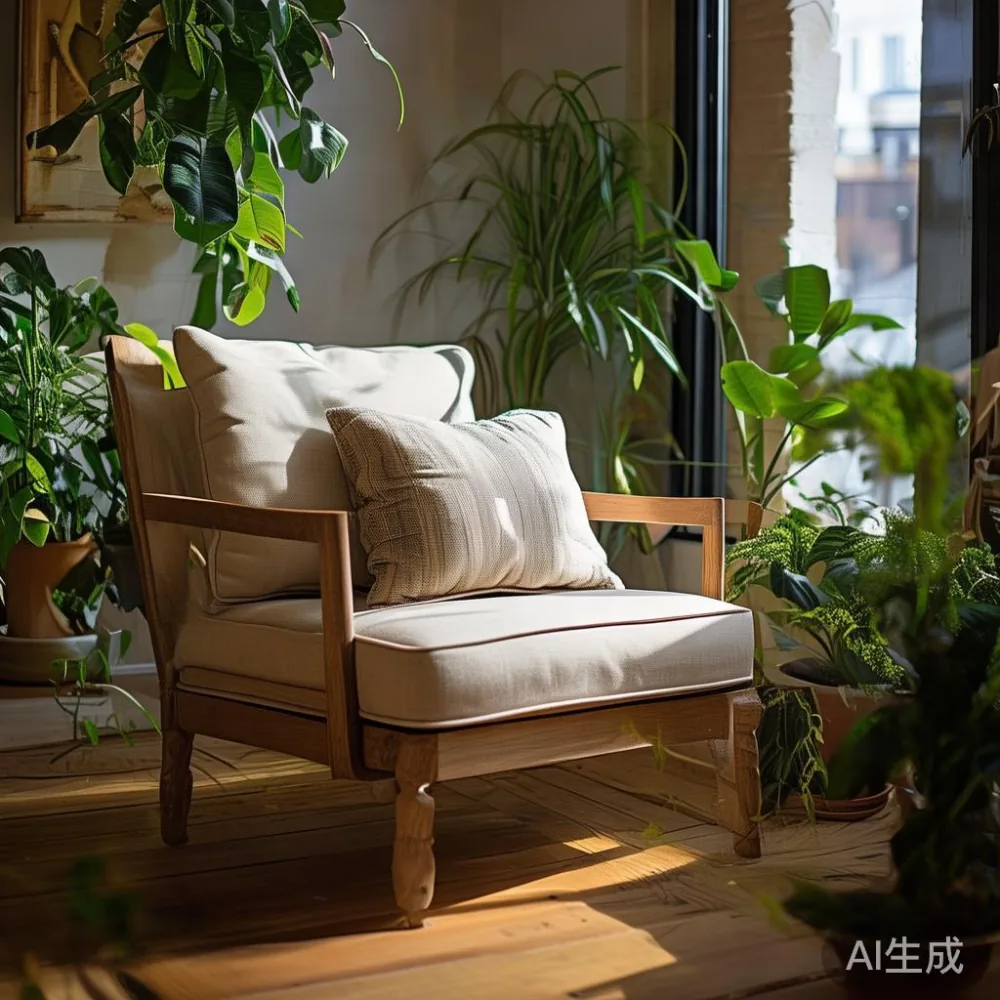
The practical question is simple: what will one accent chair cost over 5 years if it is made from veneer instead of solid wood? The answer depends on construction, care, and realistic use. A veneered chair may require less attention when its finish is intact, while a solid wood chair can usually be repaired, refinished, or reupholstered as its appearance changes. For a manufacturer such as MIDHILL, whose furniture carries a 10-year structural warranty and lifetime refinishing service, solid wood is easier to evaluate as a long-term asset rather than a short-lived styling purchase.
All prices below are in Singapore dollars and include GST where quoted as a consumer price. Delivery estimates assume normal Singapore service. Actual freight to a specific address can vary with the lift, corridor, and access conditions of an HDB block or condominium.
What does a 5-year accent chair cost really mean?
The five-year calculation has three parts: the chair bought, the maintenance required, and the replacement value. It should also include the physical cost of moving an accent chair through common areas. A standard HDB lift may have an internal door width of about 90 cm and a car depth of roughly 135 cm, so a boxed chair wider than 90 cm may not fit upright. The chair body might measure 58 cm wide by 60 cm deep by 78 cm tall, with the back rising to 82 cm when measured from the floor. Those dimensions fit many compact lift cars, but a 68 cm wide model can be awkward after assembly.
For Singapore's Bedok and Tampines blocks, corridor turns of around 90 to 120 cm are common. In newer Punggol or private condominium corridors, designers may create narrower pinch points despite more generous flat interiors. A chair delivered flat-packed may measure 112 cm long by 48 cm wide by 16 cm deep, which is easier to manoeuvre. A fully assembled solid wood accent chair can weigh 14 kg, while a veneer version may weigh 10 kg. Both are manageable, yet the heavier solid chair can be less convenient to carry up four flights when a lift is unavailable.
This is why delivery should be treated as part of the ownership experience, not as a free afterthought. MIDHILL provides free shipping on orders over US$350, while local delivery days and any quoted Singapore fee should be confirmed before purchase. A five-year cost that ignores delivery stairs or corridor clearance is incomplete.
How much do veneer and solid wood accent chairs cost in Singapore?
For a fair comparison, use chairs with similar dimensions rather than matching only style. A workable mid-range example is a 58 cm wide, 60 cm deep, and 80 cm tall accent chair with a timber frame, upholstered seat, and back cushion. A veneered model may cost S$420 including GST. A comparable solid rubberwood or ash model may cost S$680 including GST. The price difference is S$260 at purchase.
That S$260 does not automatically make solid wood the economical choice. Veneer can be appropriate for a low-traffic corner in a compact flat, especially when the chair is raised on legs, kept away from direct sunlight, and wiped dry after spills. Its surface may be stable if the substrate is well made and the adhesive seams are covered by shaped edges. However, moisture can still affect the substrate, and edge banding can chip if a chair is dragged across a tiled floor.
Solid wood is usually more useful in a family setting because scratches can be sanded, small joint movements can be corrected, and the finish can be renewed. An accent chair may be moved between the living room and bedroom, fitted beside a dining table, or used at a condo study. A solid chair weighing 14 kg is less likely to be thrown away after one awkward mark.
At the lower end of the comparison, a simple veneered accent chair might be S$280, while a solid wood version might be S$480. At the light-luxury end, a shaped solid wood accent chair with woven or fabric upholstery might be S$980, compared with S$720 for a veneered design with similar dimensions. French light luxury often favours carved edges, curved arms, and pale upholstery; post-modern light luxury might use a sculptural solid wood frame with a restrained cushion.
What maintenance costs should I budget over 5 years?
Assume the chair is used four hours a day for 365 days, or about 1,460 hours over 5 years. That is ordinary residential use for a study or reading seat. It is not a restaurant duty cycle, but it gives the comparison a consistent basis.
For a veneered accent chair, budget about S$40 in the first year for cleaning supplies and about S$20 per year thereafter. This allows for a small quantity of wood-safe cleaner, microfibre cloths, and felt pads. Some owners may pay S$25 to S$60 for a professional clean or minor touch-up during that period. A full veneer repair or replacement of a damaged panel can add roughly S$120 to S$300, depending on whether the chair can be restored in place.
For solid wood, plan on S$30 in year one for gentle cleaning and S$15 to S$25 per year after that. Sanding and refinishing are not usually routine costs; they are intervention costs. A light refresh every 18 to 24 months may be achieved with an oil or maintenance finish for around S$25 to S$50 in materials, with labour adding S$80 to S$180. The chair therefore fits neatly into a French provincial for bedroom scheme or a European light luxury nightstand arrangement without needing to be replaced when the room's textiles change.
Use an S$80 threshold for preventive care. If a chair's repair is estimated below S$80, replacing a low-cost seat fabric may be more practical than commissioning specialist work. Above S$250, a solid wood chair often retains enough value to justify restoration. Warranty and refinishing terms must still be checked for upholstery, finish, and accidental damage; a 10-year structural warranty does not mean every fabric stain is covered.
Is a solid wood accent chair cheaper after 5 years?
For the mid-range examples above, the arithmetic is revealing. Veneer: S$420 purchase price, S$140 estimated maintenance over 5 years, and S$120 as an allowance for one repair gives S$680. Solid wood: S$680 purchase price, S$130 for cleaning and one maintenance session, and a S$100 repair allowance gives S$910. On paper, veneer remains S$230 cheaper if the solid chair has no resale value.
Include a conservative residual value and the result changes. Assign the solid wood chair S$220 after 5 years because it can be refinished and moved to another room; assign the veneer chair S$70 if its edges and substrate remain sound. Solid wood then stands at S$690 in effective use cost, compared with S$610 for veneer. The two are close, rather than decisively different.
Now account for a likely second-use scenario. A family may move from a 32 m² HDB studio in Punggol to a 45 m² Bedok flat, or from a Tampines rental to a condo with a larger living area. A solid wood accent chair can follow the household because its frame can be refinished. Veneer can also move, provided its edges are not exposed to damp conditions, but a failed substrate may limit repairability.
Cost per year is another useful measure. A S$420 chair at S$70 residual value has a five-year depreciation of S$350, or S$70 per year, before maintenance. A S$680 chair with S$220 residual value depreciates by S$460, or S$92 per year. Maintenance lifts these figures to about S$97 and S$118 per year respectively. Solid wood costs more when viewed strictly as a depreciating object, but it can offer greater flexibility as furniture.
That flexibility matters around a solid wood sofa or dining table. For example, when comparing French sofa vs Mid-century modern sofa, an accent chair does not need to match either style exactly; it can act as a contrasting 1960s-inspired seat. The same chair can later sit beside a bed frame, while a marble table remains the visual centre of the room.
Which construction is easier to live with in an HDB flat or condo?
Veneer is often sensible where humidity control is good and the chair will not be dragged around. Singapore's year-round humidity commonly sits between 65% and 85%, with higher readings during wet periods. A quality product should still be protected from condensation, kitchen steam, and prolonged direct sun through a west-facing HDB window. Keep the chair at least 30 cm from an air-conditioning vent that blows continuously across its surface.
Solid wood gives a repair option, but it still needs humidity-aware care. Wipe spills within 10 minutes, use coasters and trivets, and avoid placing damp laundry directly against the frame. For bedrooms, a European light luxury nightstand can be paired with a slim solid wood accent chair if visual weight is kept controlled: choose a seat width below 60 cm and a light-coloured finish to avoid crowding a compact landing area.
Families with children should consider rounded arms and stable legs. A 14 kg solid wood chair needs to be tipped rather than lifted by its back when cleaning. Check that floor-level feet have felt or rubber pads; replacing four pads costs about S$8 to S$16. For a modern light luxury sideboard nearby, keep the accent chair 10 cm away from the cabinet face so its movement cannot scrape the sideboard.
When considering how to style American bed in room, the accent chair can become a bedside seat. A 58 cm wide chair placed beside a 160 cm bed may occupy part of the circulation route; a 50 cm wide model is more suitable in a narrow HDB bedroom. For a condo, a wider 65 cm chair may be possible, provided the lift door and bedroom doorway are measured first.
What happens if the accent chair is damaged?
Damage response is the clearest distinction. Veneer can chip along edges, crack at joints, or bubble if moisture reaches the core. If the chip is under 5 cm, a skilled repair may cost S$50 to S$120. If the substrate has swollen, replacement can cost S$250 to S$500, and availability of the original veneer may be uncertain.
Solid wood chips and scratches can often be filled and refinished. A 10 to 20 cm area may cost S$90 to S$180 to repair and refinish, while a structural joint repair might cost S$150 to S$300. A refinishable frame can also accept new upholstery. Typical seat reupholstery in Singapore may cost S$180 to S$350, depending on fabric and labour. This is why a solid wood chair often has a sensible five-year repair budget of S$180 to S$250.
For MIDHILL, the stated 10-year structural warranty and lifetime refinishing service strengthen the solid wood case. The relevant details should still be confirmed in writing: which timber species are eligible, whether refinishing is chargeable, what return freight applies, and whether the service covers the chair frame rather than the cushion. Ask for an example with an S$850 solid wood accent chair and request the service terms before payment.
One practical experience supports this distinction. Last month I visited a colleague's three-room HDB flat in Bedok and tested two nearly identical accent chairs: a 10 kg veneered model with an S$380 retail price, and a 14 kg solid ash model at S$760. I left a damp cloth on each seat for 20 minutes, then dragged one unprotected leg lightly over the tile. The veneer chair showed a dull grey abrasion and one small edge nick; the solid chair picked up a pale surface scratch that disappeared after 15 minutes of light sanding and reapplication of its hardwax oil. The test was not a product laboratory test, but it showed why finish quality and maintenance discipline still matter.
How do I choose between veneer and solid wood for my accent chair?
Choose veneer when the chair has a stable indoor location, a restrained budget, and no need for repeated refinishing. Choose solid wood when the chair will be moved, repaired, reupholstered, or kept for more than one housing change. A practical decision rule is to compare the purchase price with twice the likely repair cost. If solid wood costs S$260 more and the expected five-year repair need is below S$130, the additional spending may remain within the lower-cost option's maintenance allowance.
Measure before ordering. Record the lift door, lift depth, corridor turns, stair width, and the actual chair carton. Allow at least 5 cm of manoeuvring clearance where possible. Confirm delivery days, installation needs, return conditions, and how the 14-day returns process applies to a chair assembled or delivered to the unit. If a lift booking is required, ask whether the delivery team handles it.
Style should come after construction. A solid wood frame can support a French provincial for bedroom palette, a Mid-century modern dining table setting, or an American-style reading corner. If an accent chair must coordinate with a marble table, select a shape that does not compete with the stone's veining; a 60 cm-wide solid wood chair with a simple upholstered back can work where a carved frame would look crowded.
For most Singapore homes, the final recommendation is not “solid wood for every room.” It is to buy the accent chair according to its five-year role. Veneer can be financially reasonable for a light-use seat in a dry, stable living room. Solid wood is more adaptable for a multi-purpose chair, especially in a family flat where the piece may be repaired and moved. Budget the difference honestly, maintain either material correctly, and treat delivery clearance and warranty terms as part of the furniture's cost.